


Population growth, GDP as a measure of economic development across borders, and growth aimed at attracting investors all arguably contributed to the emergence of a wasteful make-take-waste culture. Developed nations could afford to buy, while developing countries needed to export. Without realising it, we quietly moved away from being resourceful (passing on clothes, books, etc., to siblings, between parents and children, and even within the community) towards a material world. Circularity is the replacement for what we used to call resourcefulness. If all it takes is a new name to get into the flow, let it be #circular, #circularity.
Most, if not all, products follow a linear process that begins with the extraction of raw materials for processing or manufacturing, then moves to distribution, the shelf, and eventually use and disposal, essentially a take-make-use-dispose model that is arguably unsustainable and harmful to the environment. Design decisions, including material selection, manufacturing processes, and product life and use, account for 80% of the environmental impact (How ecodesign can help the environment by making products smarter your future, 2012).
For example, healthcare waste is predicted to reach 200,000 tons in England by 2030 (NHS clinical waste strategy, 2023). It is equally worrying across other sectors and industries, perhaps even more alarming when examined more closely. When things are out of sight, they are out of mind, which does no favours and can unconsciously lead to waste.
One solution to the unconsciously produced waste is to design with circularity in mind, that is, to think beyond the linear economy and aim for a circular economy through the 9R strategies, the image on the right (Potting et al., 2017) for smarter product use and manufacturing, to extend the lifespan of products and their parts, and to ensure the useful application of materials. Today, regardless of borders, it is important not to become fixated solely on the technicalities of circular design and to expect decisionmakers not to ask questions simply because it is circular. Equally important is building rapport with decisionmakers through a compelling story about the business model that brings the value proposition to life and focusing on the economics of revenue drivers (customer/consumer segments, channels, and relationships) as well as costs (key resources, activities, and partnerships).
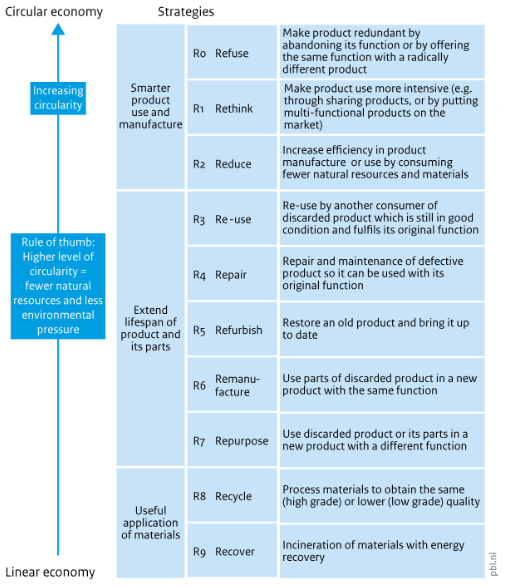
(Potting et al., 2017)
As a Sustainability apprentice, I am taught the linear industrial economy is about flows (in other words, turning various forms of capital into financial capital), whereas the circular economy is about stocks, where quantity and quality are intertwined. The good news is that we are increasingly seeing circularity in two forms: the circular material economy and the circular user economy, evident in everything from bicycles to taxis to accommodation.
In my opinion, circular design requires a similar mindset like Plan-Do-Check-Act embedded within the ISO standards. It needs to be understood by creating solutions that solve people's problems, with a user focus that discovers needs (not asking for wants). Then define by using research to solve the right challenge, testing with users to ensure needs are met, leading to prototyping and releasing (launching). Circular design is restorative and ensures three principles: eliminating waste and pollution; keeping products, materials, and resources in use to circulate; and regenerating. It moves from traditional discipline-specific work to system-level (trans-disciplinary) thinking at all levels, enabling people to hold a broad, holistic view that helps make connections, see possibilities, and adapt in response to stakeholder feedback.
Finally, there are many good resources in public domain promoting resource management by designing material recovery and by encouraging manufacturers to design reuse. They also promote redesigning for leasing, service, and longevity. The Ellen MacArthur Foundation's butterfly diagram, with the biological and technical cycles (The butterfly diagram: Visualising the circular economy, 2021), highlights value creation in the Circular Economy: the inner circle aims to minimise the use of materials and resources, while the outer circle aims to extend the life of the product.
Related reading: If you're interested in how these ideas connect to broader sustainability practice, I've written previously about how integrated ISO 9001, 14001, and 45001 management systems drive efficiency and risk control, and about Life Cycle Assessment as the tool for turning inputs into measurable environmental impacts.
References:
The butterfly diagram: Visualising the circular economy. Ellen MacArthur Foundation. (2021, February 12). https://www.ellenmacarthurfoundation.org/circular-economy-diagram
How ecodesign can help the environment by making products smarter your future. European Union. (2012, February 15). https://build-up.ec.europa.eu/sites/default/files/content/Brochure-Ecodesign-Your-Future-15022012.pdf
NHS clinical waste strategy. NHS England. (2023, March 7). https://www.england.nhs.uk/long-read/nhs-clinical-waste-strategy/
Potting, J., Hekkert, M., Worrell, E., & Hanemaaijer, A. (2017, January). Circular economy: Measuring innovation in the product chain policy report. PBL Netherlands Environmental Assessment Agency. https://www.pbl.nl/uploads/default/downloads/pbl-2016-circular-economy-measuring-innovation-in-product-chains-2544.pdf
/Passle/5e4a7839abdfeb03584d01f6/MediaLibrary/Images/2026-03-31-21-45-54-751-69cc4092bd1f61a396ba5dbf.png)
/Passle/5e4a7839abdfeb03584d01f6/SearchServiceImages/2026-10-15-20-52-56-997-6ad13d285c647470665fe605.jpg)
/Passle/5e4a7839abdfeb03584d01f6/MediaLibrary/Images/2026-09-03-20-12-26-473-6a99d4aab11f9687508d5b0a.png)
/Passle/5e4a7839abdfeb03584d01f6/MediaLibrary/Images/2026-09-04-00-16-53-479-6a9a0df5b6215d2dde2b7c7b.png)