

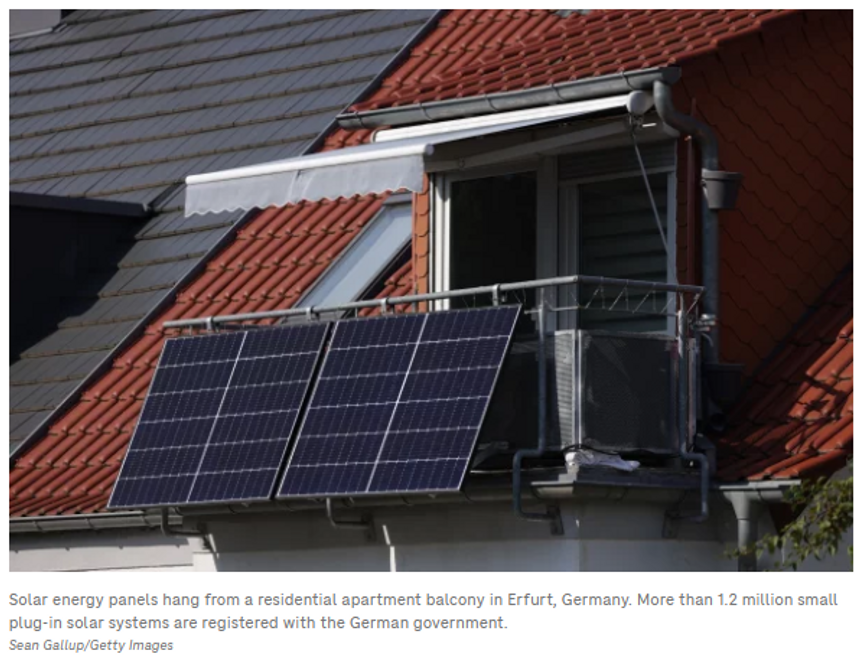
How would you like to have a easy-to-use solar panel that plugs right into a wall socket and helps to deliver solar energy and offers relief from skyrocketing electricity bills? Sounds awesome, sign me up!
"A year ago, nobody was talking about this," says Cora Stryker, co-founder of Bright Saver, a California nonprofit group that advocates for plug-in solar. The panels are already popular in Germany, where more than 1.2 million of the small plug-in systems are registered with the German government.
For the panels to become more widely available in the U.S., state lawmakers are proposing bills that eliminate complicated utility connection agreements, which are required for larger rooftop solar installations and, most utilities say, should apply to plug-in solar too. Those agreements, along with permitting and other installation costs, can double the price of solar panels.
Utah enacted the first law, last May, supporting plug-in solar, and now some 30 pieces of similar legislation have been introduced around the United States. But the drive toward plug-in solar is facing pushback from electric utilities. They are raising safety concerns and prompting legislators to delay votes on the bills. So far, utilities have won over lawmakers in five states and convinced them to delay votes on plug-in solar bills.
Plug-in solar advocates say that safety concerns about the new technology have been addressed and that utilities are really just worried about losing business, because every kilowatt-hour generated by a plug-in solar panel is one less the utility sells to a customer.
There are safety risks with any electrical appliance, and it's true that plug-in solar panels present some unique problems. But safety experts also say those issues can be managed.
Traditional solar panel systems, which can cost more than $20,000, are bolted to a homeowner's roof. As a result, they're usually not a safety concern for the public because they're not easily accessible. Plug-in panels cost much less and generate enough electricity to power a refrigerator or microwave.
They can sit on a balcony, hang out a window or be set up in a backyard. They collect energy from the sun and then feed electricity into a home through a regular outlet, displacing electricity that otherwise would come in from the grid. That makes them easier to install but also more easily accessible to people who aren't used to being around appliances that generate electricity, where the plug can present more of a shock hazard.
Nationally Recognized Testing Labs, such as Intertek, offer thorough electrical and safety validation services to ensure that these products are safe for use and deliver the promises made. Not only does Intertek offer electrical safety testing, but they also have vast expertise in Solar Testing & Photovoltaic (PV) Systems. You can learn more at: https://www.intertek.com/solar/
In Germany, smaller plug-in panels cost just a few hundred dollars, and customers can recover that in saved energy bills within seven years. The panels should continue to produce power for up to 30 years.
Stryker says plug-in solar took off in Germany once renters were allowed to install the systems, and she sees the potential for a similar trajectory in the United States.
/Passle/5e4a7839abdfeb03584d01f6/SearchServiceImages/2026-10-15-20-52-56-997-6ad13d285c647470665fe605.jpg)
/Passle/5e4a7839abdfeb03584d01f6/MediaLibrary/Images/2026-09-03-20-12-26-473-6a99d4aab11f9687508d5b0a.png)
/Passle/5e4a7839abdfeb03584d01f6/SearchServiceImages/2026-09-04-22-12-18-466-6a9b4242f67b2e9362bccbfa.jpg)