


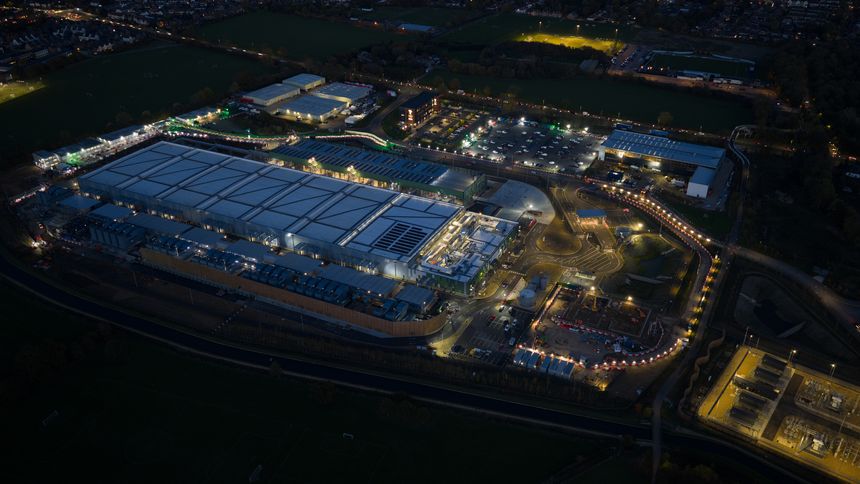
Not every data center is built for the same purpose.
Some support internal business systems. Some host infrastructure for many customers. Others are designed for massive cloud platforms, low-latency edge computing, or specialized workloads such as AI, high-performance computing, healthcare, finance, and regulated industries.
That matters because the assurance strategy should not be the same for all of them.
A data center is not just racks, servers, cables, and cooling. It is a system built around a business need. And when the purpose changes, the risk profile changes with it.
Different facilities, different risks
An enterprise data center is usually focused on supporting the internal operations of one organization. The concern is often continuity, security, and keeping critical business applications available.
A colocation facility introduces a different challenge. Multiple organizations may depend on the same building infrastructure, while still managing their own IT equipment. That makes physical security, power reliability, cooling, access control, and clear responsibility boundaries especially important.
Hyperscale data centers are different again. They are designed for massive compute, storage, automation, and horizontal scalability. Small design decisions in these environments can have a large impact on performance, reliability, energy use, and operating cost.
Edge data centers bring compute closer to users, devices, or branch locations to reduce latency and support real-time applications such as IoT, smart cities, and industrial systems. That makes availability important, but it also increases the number of distributed sites that must be managed consistently.
Then there are specialized data centers. AI, HPC, financial systems, government infrastructure, healthcare, and other regulated environments often require more than standard IT reliability. They may demand higher density, tighter environmental control, stronger cybersecurity, or more formal compliance evidence.
The design question is really an assurance question
Choosing a data center model is not only an IT architecture decision. It is an assurance decision.
The right facility depends on what the organization needs to run, protect, and scale. That means teams need to consider more than capacity. They need to think about how the facility will perform under stress, how failures will be contained, and how compliance will be demonstrated over time.
A well-designed data center should account for:
- Workload type and performance requirements
- Latency, redundancy, and scalability
- Power, cooling, physical security, and regulatory expectations
These factors are central to selecting the right data center model and ensuring the facility supports the intended business and technical outcomes.
Why system-level thinking matters
Modern data centers are tightly connected systems. Compute, networking, power, cooling, cabling, and facility infrastructure all affect one another.
That is why assurance cannot focus on one layer at a time.
A high-performance server environment can still fail if airflow is poor. A resilient network can still be limited by weak power distribution. A cloud-scale platform can still suffer if cabling, cooling, or redundancy planning creates hidden bottlenecks.
At scale, small issues multiply quickly.
How Intertek can support
Intertek supports data center owners, operators, designers, and technology providers by helping verify that critical systems perform as intended.
That can include testing, inspection, commissioning, certification, and performance evaluation across electrical, mechanical, cooling, enclosure, ICT, cybersecurity, and operational systems.
The goal is simple: to provide independent evidence that the data center is not only designed correctly, but capable of delivering the reliability, safety, efficiency, and compliance expected of its role.
Final thought
A data center should be judged by how well it fits its purpose.
Enterprise, colocation, hyperscale, edge, and specialized facilities all solve different problems. They also create different risks.
That is why assurance must match the model.
Because in modern digital infrastructure, the question is not just, “Where will the servers go?”
It is, “Can this facility reliably support the workloads, risks, and obligations it was built for?”
/Passle/5e4a7839abdfeb03584d01f6/MediaLibrary/Images/2026-03-31-21-45-54-751-69cc4092bd1f61a396ba5dbf.png)
/Passle/5e4a7839abdfeb03584d01f6/MediaLibrary/Images/2026-09-03-20-12-26-473-6a99d4aab11f9687508d5b0a.png)
/Passle/5e4a7839abdfeb03584d01f6/SearchServiceImages/2026-09-04-22-12-18-466-6a9b4242f67b2e9362bccbfa.jpg)
/Passle/5e4a7839abdfeb03584d01f6/MediaLibrary/Images/2026-09-04-00-16-53-479-6a9a0df5b6215d2dde2b7c7b.png)