


One observation has remained remarkably consistent throughout my career: organisations that create the greatest value from certification rarely focus exclusively on obtaining a certificate. They use certification as a platform to strengthen governance, build confidence, earn trust and improve business performance.
I have seen this distinction repeatedly: the certification may open the door, but the discipline and confidence built around it determine the value that follows.
Today's business environment is shaped by complex supply chains, increasing stakeholder expectations and evolving regulations. Information travels instantly. An organisation's reputation can change within hours. Decisions made across extended supply chains, including suppliers, subcontractors and business partners, can quickly become the concern of customers, regulators, investors, the media and the public.
Against this backdrop, compliance remains essential. It provides structure, consistency and a common framework for managing risk. Leading organisations understand that compliance establishes the foundation for a much broader journey.
The Challenge Is Larger Than Compliance
Across industries, examples continue to demonstrate the scale of today's challenges. In the UK alone, food recalls increased by 23% in 2025. Foodborne illness is estimated to cost the UK economy £10.4b annually, while food fraud and food crime are estimated to cost between £409m and £1.96b each year.
Beyond food, organisations continue to face supply chain disruptions, cybersecurity incidents, product quality failures, sustainability concerns and increasing scrutiny of supplier practices.
The automotive industry has experienced repeated production disruptions caused by cyber-attacks and supplier failures. In 2024, the ransomware attack on CDK Global disrupted operations at more than 15,000 automotive dealerships across North America, with initial estimates of $944m in financial losses. The incident demonstrated how disruption at a critical service provider can affect an entire business ecosystem.
In the UK, the ransomware attack on KNP Logistics forced the 158-year-old company to permanently shut down its operations after its critical systems were compromised, illustrating how cyber resilience has become a governance issue rather than solely an IT issue.
Many of these incidents occur within industries that already operate under extensive regulatory and compliance frameworks.
The question for business leaders, therefore, is whether their systems simply demonstrate compliance at a point in time, or provide the visibility and resilience needed when conditions change. Standards, regulations and certifications create an essential foundation. Confidence, visibility and trust determine how effectively organisations navigate complexity, manage risk and respond when challenges arise.
Confidence Is Built Through Evidence
Stakeholders increasingly seek evidence. Customers want confidence in product quality and service delivery. Regulators seek confidence in governance and compliance. Investors look for confidence in resilience and long-term performance. Business partners value confidence in supply chain integrity and operational reliability.
Independent verification creates value by replacing assumptions with objective evidence. Third-party assessments, audits and certification programmes provide assurance that systems and controls are operating as intended. They help organisations demonstrate capability, consistency and accountability.
I saw this principle first-hand during The FIFA World Cup Qatar 2022™, where our team worked with Qatar's Ministry of Public Health to deliver a large-scale inspection and verification programme across food service operations. Through risk-based inspections, daily reporting and real-time feedback, the programme strengthened oversight and helped address risks quickly across a highly complex operating environment. It was a powerful reminder that independent assurance creates its greatest value when it supports better decisions in real time. A link to the case study is included in the references below.
Creating Value Through Assurance
The organisations that derive the greatest value from assurance view every audit as an opportunity to learn. Audit findings help strengthen controls, identify emerging risks and support better decision-making. Benchmarking provides additional perspective, helping organisations understand where they perform well and where further improvements can be made. In this way, assurance becomes part of the way successful organisations learn, adapt and improve.
The business value can also be measurable. In one case, a global consumer goods brand implemented a tailored, risk-based assurance programme across 15 factories in Asia. Within 6–9 months, all 15 factories achieved self-inspection status, defect rates reduced significantly, and the client saved more than $100,000 annually per factory. The case demonstrates how targeted assurance can translate into measurable improvements in quality, operational performance and cost. A link to the case study is included in the references below.
The value of assurance is often found in the insights it generates, the actions it inspires and the improvements that follow.
Certification as a Strategic Asset
Certification supports access to markets, customer opportunities and stakeholder confidence. In many industries, it plays an important role in supplier qualification, procurement decisions and market access. For many organisations, certification can influence whether they qualify for a tender, satisfy a major customer's requirements or access a new market.
The most mature organisations integrate certification into their broader business strategy. They use it to strengthen governance, improve operational discipline, enhance customer confidence and support growth.
Over time, these outcomes contribute to something far more valuable than a certificate. Customers gain confidence with every successful interaction, and that confidence strengthens relationships and creates lasting competitive advantage.
I recall one of our strategic customers in the manufacturing sector who viewed certification as an integral part of their growth strategy. By maintaining an integrated certification process across 19 sites, they demonstrated consistency and credibility to internal and external stakeholders. They actively sought to maximise the value of every audit, engaging with our auditors to gain insights and act on opportunities for improvement. Certification became much more than evidence of compliance. It became part of how they built confidence in their operations and supported business growth.
Looking Ahead
Technology is reshaping the assurance landscape. AI and advanced analytics are creating new opportunities to improve visibility, strengthen risk management and respond more quickly to emerging threats.
While the tools and systems continue to evolve, the underlying objective remains unchanged. Organisations still need to demonstrate that they can consistently deliver on their commitments, manage risk effectively and earn the confidence of those who depend on them.
The greatest opportunity lies in embedding certification into the way organisations govern, manage risk, improve performance and strengthen stakeholder confidence.
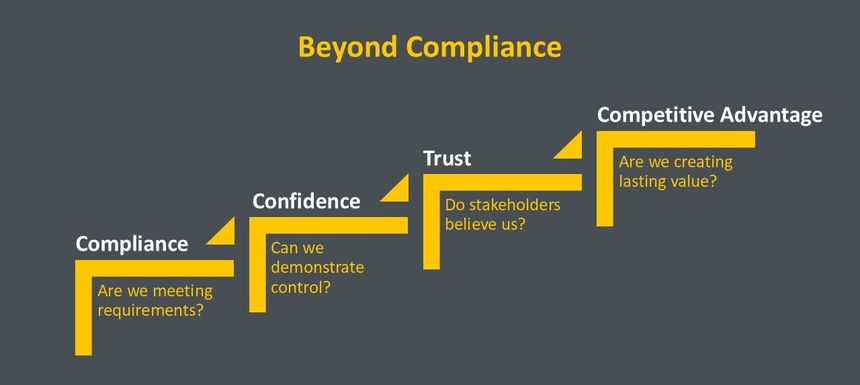
The organisations that convert compliance into confidence, confidence into trust, and trust into competitive advantage will be the ones that lead the future of their industry.
Discover how Intertek can help: https://www.intertek.com/assurance/
References:
- https://www.intertek.com/business-assurance/
- https://www.gov.uk/government/organisations/food-standards-agency
- https://www.food.gov.uk/research/the-cost-of-food-crime-phase-2-results
- https://www.thegrocer.co.uk/news/aldi-and-lidl-top-2025-product-recall-league-table/716031.article
- https://www.cbsnews.com/news/cdk-cyber-attack-update-some-systems-restored/
- https://www.bbc.com/news/articles/cx2gx28815wo
- Case study: FIFA World Cup Qatar 2022
- Case study: $100k annual savings per factory
/Passle/5e4a7839abdfeb03584d01f6/MediaLibrary/Images/2026-03-31-21-45-54-751-69cc4092bd1f61a396ba5dbf.png)
/Passle/5e4a7839abdfeb03584d01f6/SearchServiceImages/2026-10-15-20-52-56-997-6ad13d285c647470665fe605.jpg)
/Passle/5e4a7839abdfeb03584d01f6/MediaLibrary/Images/2026-09-03-20-12-26-473-6a99d4aab11f9687508d5b0a.png)
/Passle/5e4a7839abdfeb03584d01f6/SearchServiceImages/2026-09-04-22-12-18-466-6a9b4242f67b2e9362bccbfa.jpg)