


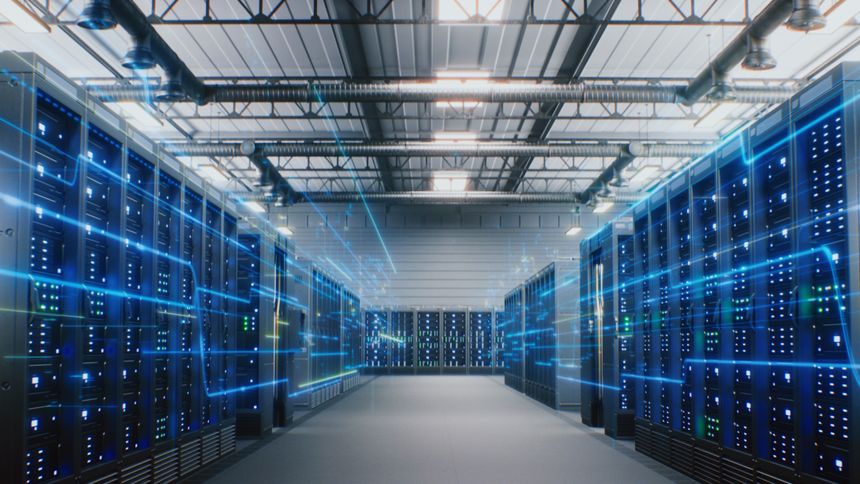
For decades, system assurance focused on validating individual components, subsystems, and bounded architectures. Today, that model is no longer sufficient. The global expansion of hyperscale data centers (driven by AI, advanced simulation, and cloud computing) is fundamentally changing how complex systems are designed, modeled, and assured.
We are entering an era where assurance is no longer about isolated products or facilities, but about validating dynamic, interconnected system‑of‑systems operating at unprecedented scale.
From Component Assurance to System‑of‑Systems Validation
Traditional engineering assurance relied on abstraction. Engineers broke systems into manageable pieces, verified each against known requirements, and assumed controlled interactions at integration.
Hyperscale data centers have disrupted that approach. Massive compute availability now supports:
- Large‑scale multi‑physics simulations
- Continuous system monitoring
- Real‑time performance modeling
- Rapid iteration driven by software updates
Where abstraction once reduced complexity, modern data‑center‑enabled engineering increases fidelity by modeling interactions across entire systems simultaneously.
Assurance must evolve to match this shift, and as the digital twins scale, assurance challenges intensify, and new questions arise:
- How do we validate model accuracy across heterogeneous data sources?
- How do we ensure predictions remain trustworthy as systems evolve?
- How do we manage risk when decisions are driven by simulated outcomes rather than physical testing?
At scale, trust in digital twins becomes a safety issue, not just a modeling concern.
Semiconductor Manufacturing: A Case Study in Complexity
Nowhere is the impact more visible than in semiconductor manufacturing.
Modern fabs represent some of the most complex engineered systems ever built—featuring hundreds of tightly coupled process steps, extreme sensitivity to variation, and interactions across materials science, thermal physics, chemistry, and electrical performance.
As technologies such as 3D‑ICs, chiplets, and heterogeneous multi‑die packaging become mainstream, traditional predictive models struggle to capture emergent behavior.
Large‑scale simulation and digital twin frameworks are becoming essential. But assuring these models is now as critical as assuring the physical tools themselves.
The Physical Reality Beneath the Digital Layer
Despite their virtual sophistication, digital systems remain anchored to physical infrastructure.
Data centers are industrial facilities with:
- Continuous electrical loads
- Tight thermal margins
- Complex cooling strategies
- High‑density equipment installations
- Cyber‑physical dependencies
Failures at the physical layer cascade rapidly into digital outages—making electrical, mechanical, environmental, and ICT assurance inseparable.
System assurance must therefore validate a variety of elements such as power resilience under load, cooling effectiveness, enclosure integrity, and operational reliability throughout the facility lifecycle.
How Intertek Supports the New Assurance Landscape
Intertek’s role in this evolving environment spans physical infrastructure, digital systems, and lifecycle governance:
- Data Center Testing, Inspection, and Commissioning
Validating performance across electrical, mechanical, thermal, enclosure, and ICT systems from design through operation. - System‑Level Risk Assessment
Identifying interactions that emerge only at scale—between software, hardware, and operational environments. - Digital and AI Assurance
Supporting the validation of advanced simulation, digital twin, and AI‑enabled systems to ensure they remain accurate, secure, and trustworthy over time. - Lifecycle‑Focused Assurance Strategies
Moving beyond point‑in‑time certification to ongoing, performance‑based assurance.
Looking Ahead: Assurance Becomes a Strategic Capability
As hyperscale data centers continue to power innovation across AI, infrastructure, manufacturing, and urban systems, assurance is no longer a back‑end function.
It becomes a strategic enabler, ensuring that digital ambition does not outrun physical reality, and that complexity does not undermine trust.
The future of system assurance will not be smaller, simpler, or faster.
It will be deeper, broader, and more essential than ever.
/Passle/5e4a7839abdfeb03584d01f6/MediaLibrary/Images/2026-03-31-21-45-54-751-69cc4092bd1f61a396ba5dbf.png)
/Passle/5e4a7839abdfeb03584d01f6/SearchServiceImages/2026-10-15-20-52-56-997-6ad13d285c647470665fe605.jpg)
/Passle/5e4a7839abdfeb03584d01f6/MediaLibrary/Images/2026-09-03-20-12-26-473-6a99d4aab11f9687508d5b0a.png)
/Passle/5e4a7839abdfeb03584d01f6/SearchServiceImages/2026-09-04-22-12-18-466-6a9b4242f67b2e9362bccbfa.jpg)