

Why connected expertise matters in pharmaceutical testing
Pharmaceutical testing rarely follows a perfectly straight line.
A question about packaging material may lead to questions about extractables and leachables. A container system may raise considerations around integrity. With a pre-filled syringe, mechanical performance, material interactions, formulation, and aging may all need to be considered.
Each question may require a different methodology, but that does not mean the questions are unrelated.
At Intertek’s Whitehouse Laboratory, scientists working across Extractables & Leachables (E&L), Proteins & Peptides, Container Closure Integrity Testing (CCIT), and Medical Device Testing are based within the same laboratory. This creates opportunities for different scientific disciplines to work together when a program crosses traditional testing boundaries.
Extractables & Leachables (E&L)
Materials used in pharmaceutical packaging and processing systems can raise analytical questions of their own.
E&L considerations can extend across primary container closures such as glass vials, pre-filled syringes and IV bags, as well as secondary packaging and single-use or multi-use bioprocessing components.
Depending on the program, understanding these materials may involve extraction screening, leachables method development and validation, stability monitoring, or identification of unknown impurities.
Importantly, those findings do not necessarily exist independently from questions about packaging integrity or device performance. Looking across disciplines can help provide a broader understanding of the product and package system.
For additional technical information:
Download the Extractables & Leachables Brochure
https://www.intertek.com/pharmaceutical/analysis/extractables-leachables/extractables-leachables-brochure-whitehouse-nj/
Proteins & Peptides
For proteins and peptides, analytical requirements can evolve considerably as a program progresses.
Early characterization and method development may eventually lead to validation, impurity monitoring, release testing, and long-term stability. This means the analytical strategy may need to evolve alongside the program itself.
At Whitehouse, work with synthetic peptides, biologics, and generic GLP-1 analogs can include intact mass identification, sequence profiling, purity and counterion assay quantitation, degradation and process impurity tracking, elemental impurity screening, and method development and validation.
The value lies not simply in an individual analytical technique, but in understanding how the information generated at different stages contributes to the broader program.
For questions related to Proteins & Peptides, feel free to reach out to me directly at tia.volker@intertek.com.
Container Closure Integrity Testing (CCIT)
CCIT provides a clear example of why analytical context matters.
Selecting an appropriate testing strategy begins with understanding the package format, dosage form and product state, potential leak pathway, product–package interactions, storage and distribution conditions, and intended lifecycle use.
Given the recent changes and push for more quantitative approaches using deterministic test methods such as Vacuum Decay, High Voltage Leak Detection (HVLD), Helium Leak Detection, Mass Extraction, or Headspace Analysis has become the expectation and not the exception. Selecting the right approach requires a thorough understanding of the package system, its components, the potential leak pathways, and the intended application. For example, Helium Leak testing can offer valuable insight into leak characteristics and package performance, while our Residual Seal Force (RSF) testing offers complementary information on stopper compression and capping consistency. Together, these techniques can help build a more complete understanding of container closure performance and potential failure mechanisms.Whether the question involves primary package design features, assembly and manufacturing processes, or the development of a container closure integrity strategy as part of a sterility assurance program, Intertek has proven scientific approaches and testing solutions to support informed decision-making.
The important question is not simply which technology is available. It is whether the package design, product matrix, anticipated failure mode, method observable, detection capability, challenge controls, acceptance criteria, and intended lifecycle application form a coherent scientific control strategy.
For those interested in exploring CCIT further, my colleague Michael Dominguez has shared his perspective in two recent articles:
Navigating FDA, EMA, and ICH Guidance on CCI and Sterility Assurance
https://assuranceinaction.intertek.com/post/102n156/navigating-fda-ema-and-ich-guidance-on-cci-and-sterility-assurance
Strategic Importance of Container Closure Integrity in Pharmaceutical Manufacturing
https://assuranceinaction.intertek.com/post/102mryt/strategic-importance-of-container-closure-integrity-in-pharmaceutical-manufacturi
Additional technical information is available here:
Container Closure Integrity Testing
https://www.intertek.com/pharmaceutical/analysis/container-closure-integrity-services/
Medical Device Testing
Mechanical and functional testing introduces another analytical perspective, particularly for prefilled syringes and other drug-device combination products.
Understanding system performance may involve measurements such as break-loose force, glide or extrusion force, complete force-displacement profiles, stick-slip behavior, closure or needle-shield removal force, needle pull-out force, plunger-rod engagement, activation force, dose accuracy, injection time, delivered volume, or individual component strength.
These measurements can help evaluate the effects of variables such as barrel and stopper dimensions, stopper formulation, lubrication or siliconization, product viscosity, formulation interactions, assembly conditions, storage orientation, aging, thermal exposure, transportation stress, and repeated handling.
Current FDA and EMA direction makes it increasingly important to connect each mechanical result to a defined failure mode, intended user, critical task, clinically relevant output, acceptance criterion, and lifecycle stage. For example, a prefilled syringe can remain leak-tight but develop excessive break-loose or glide force that prevents reliable dose delivery. Conversely, a system may meet its initial mechanical-force requirements but experience loss of seal integrity during storage or transportation.
Integrity and functionality should therefore be evaluated together but should not be treated as interchangeable quality attributes. CCIT establishes whether the package maintains its required barrier properties. Functional and mechanical testing establishes whether the system can perform its intended preparation, handling, activation, and delivery functions. FDA’s 2026 drafts expressly bring container-closure quality, compatibility, device performance, stability, user-interface analysis, and critical-task evaluation into a common presentation-level framework.
This is where the connection between disciplines becomes especially relevant. A mechanical-performance question may intersect with container integrity, material properties, lubrication, formulation rheology, extractables and leachables, stability, human factors, or manufacturing variability. The device and package system should therefore be assessed as an integrated product rather than an unrelated collection of individual components and tests.
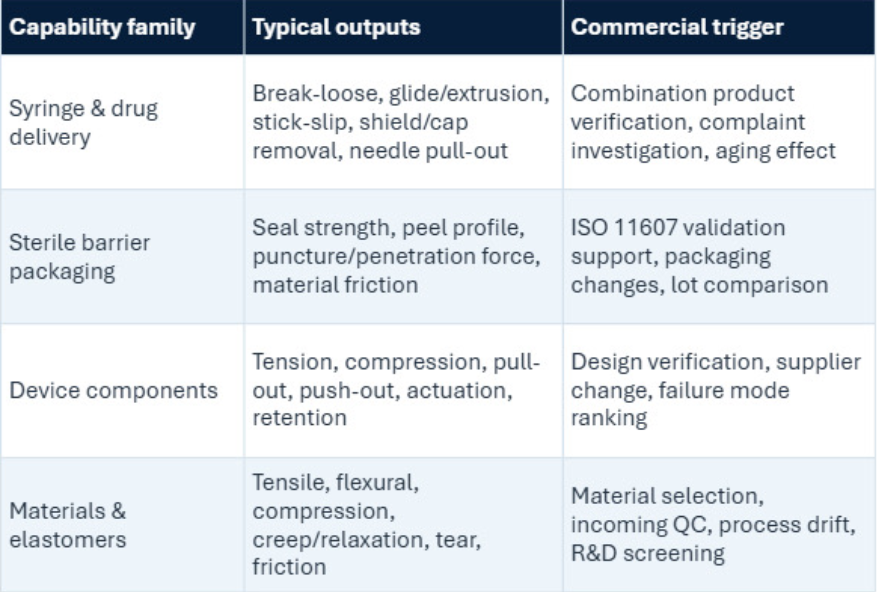
Examples of mechanical and functional testing considerations across device and package systems.
Further information is available here: https://www.intertek.com/pharmaceutical/analysis/pre-filled-syringe-testing/
Connecting the Analytical Picture
The benefit of having these disciplines within one laboratory is not simply having multiple methodologies available.
It is the opportunity to look at a question from more than one scientific perspective.
A material question may become an E&L question. A package concern may lead to questions pertaining CCIT. Device performance may need to be considered alongside aging or formulation. Analytical requirements for a peptide may change as the program progresses.
Having scientists across these areas working within Intertek’s Whitehouse Laboratory creates an environment where those connections can be considered as the questions evolve.
Because sometimes the most useful insight does not come from performing another test. It comes from understanding how the results fit together.
Every program brings different questions. If something discussed here reflects a challenge you're currently working through, feel free to reach out to our expert directly at tia.volker@intertek.com.

/Passle/5e4a7839abdfeb03584d01f6/MediaLibrary/Images/2026-03-31-21-45-54-751-69cc4092bd1f61a396ba5dbf.png)
/Passle/5e4a7839abdfeb03584d01f6/SearchServiceImages/2026-10-15-20-52-56-997-6ad13d285c647470665fe605.jpg)
/Passle/5e4a7839abdfeb03584d01f6/MediaLibrary/Images/2026-09-03-20-12-26-473-6a99d4aab11f9687508d5b0a.png)
/Passle/5e4a7839abdfeb03584d01f6/SearchServiceImages/2026-09-04-22-12-18-466-6a9b4242f67b2e9362bccbfa.jpg)