


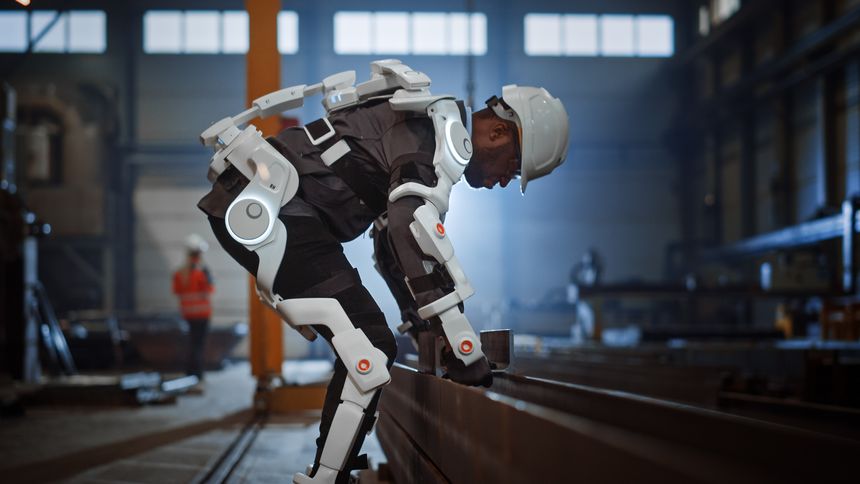
Wearable exoskeletons were once the domain of medical rehab labs and science fiction, but now they are rapidly becoming mainstream tools for reducing workplace injuries. As organizations search for new ways to protect workers from musculoskeletal disorders (MSDs), fatigue, and overexertion, industrial exosuits are emerging as one of the most effective engineering controls available today.
But with rapid adoption comes a critical question: How do we ensure exoskeletons are safe, reliable, and designed to protect workers, not introduce new risks?
That’s where ISO 13482 comes in. It is a global safety standard specifically created for personal care robots, including wearable robotic devices.
A Growing Body of Evidence: Exoskeletons Really Do Reduce Injuries
Data from real-world deployments is starting to be published, and it is validating what early adopters observed: properly designed exoskeletons significantly reduce strain, fatigue, and injury rates in physically demanding jobs.
According to EHS Today, a large multi‑site study found:
- 62% reduction in total strain and sprain injuries among workers wearing exosuits.
- Injury frequency dropped from 10.2% to 3.8% (per 100 workers per year).
- Injuries decreased from one every 20,000 work hours to fewer than one every 50,000, with zero back injuries recorded.
- Over 311,000 work hours were evaluated across food & beverage, retail, manufacturing, and warehousing sectors.
A car manufacturer reported similar outcomes, adopting over 500 shoulder exoskeletons after internal studies showed a 20% reduction in muscle load for workers performing overhead tasks.
A third companies wearable‑tech study saw:
- 72% reduction in improper postures
- 19% decrease in injury rates
- 67% reduction in lost‑time injuries
Exoskeletons are part of the current industrial revolution we are seeing, in that robotics are enhancing our existing workplace, allowing them to do their job faster and safer. When safer work practices and more efficient work practices can be combined - everyone wins!
ISO 13482: The Safety Standard Industrial Exoskeletons Can’t Ignore
ISO 13482 provides requirements for the design, risk assessment, and validation of personal care robots. A key category of 'personal care robotics are wearable robots and exoskeletons.
Key ISO 13482 safety domains relevant to industrial exo-suits include:
1. Physical Human–Robot Interaction Safety
Exoskeletons operate in continuous contact with the body, so ISO 13482 requires protection for users. Some of these Human-Robotic interactions include restricting excessive force and pressure on limbs, and misalignment that could lead to joint strain. Additionally, as found in many ‘traditional’ standards, pinch points, hot surfaces, and sharp edges must be addressed.
2. Operational Safety & Failure Handling
Safety of exoskeletons in normal and abnormal use is critical for users to have trust in the system. To this end, the products must demonstrate safe behavior during electrical or mechanical failures.
The predictability of robots is important - especially when robots are in direct contact with humans, as such sudden or uncontrolled movements are another factor that ISO 13482 addresses to increase trust in the robots.
3. Usability and Ergonomics
ISO 13482 recognizes that comfort and fit are not “nice to haves”, they are core safety factors. The intention is that these exoskeletons be used for hours at a time, and weeks on end. Poor fitting exoskeletons can shift loads to unintended body regions, potentially increasing injury risk.
ISO 13482 Starting Point: The Need for Structured Risk Assessment
Risk assessment is the first step to conformance with ISO 13482 - as it is with almost all robotic standards. Despite the real‑world results, exoskeletons introduce new engineering, ergonomic, and operational risks that must be addressed. ISO 13482 requires the risk assessment to specifically address factors that are unique to exo-skeletons and that may otherwise be overlooked. Some of these items include:
- Body‑segment loads with and without the device
- Support levels during dynamic motion
- Long‑term exposure to assistance forces
- Interaction with PPE, tools, and job‑specific tasks
- Variability between individual workers (strength, height, mobility)
The EHS Today article highlights an important point: injury reductions occurred without increasing Musculoskeletal Disorders (or MSDs) in other body regions, meaning forces weren’t simply “relocated” to another joint.
ISO 13482 supports this by requiring verification that risk is not unintentionally shifted elsewhere in the body.
Where Intertek Helps: Assurance for Safe, Effective Exoskeleton Deployment
As adoption accelerates, and as global employee‑safety expectations rise, manufacturers and employers need structured, third‑party assurance. Intertek’s services support both product manufacturers and end‑user organizations across the entire lifecycle:
For Exoskeleton Manufacturers
- ISO 13482 compliance assessments
- Cybersecurity and AI testing and evaluation
- Mechanical and biomechanical safety testing
- Functional safety training and evaluations
- Failure‑mode and fault‑tolerance analysis
- Material and durability testing
- Battery testing and certification
For Employers Deploying Exoskeletons
- Task‑specific risk assessments under ISO 12100 and ISO 13482 principles
- Pilot deployment safety evaluations
- Fit‑for‑purpose evaluations to match devices to job tasks
- Behavior and injury‑trend analysis to confirm real‑world benefits
- Worker training and safe‑use guidance
With a flood of new commercial exoskeleton designs hitting the market and global demand expected to reach $1.25 billion by 2030, organizations need more than vendor claims—they need validated, evidence‑based assurance.
Exoskeletons Are Ready, If Safety Comes First
Exoskeletons are no longer experimental. They’re delivering measurable injury reductions across major industries—logistics, automotive, manufacturing, and distribution. But their success depends on human‑centric design, standards‑based safety, and proper verification.
ISO 13482 provides the blueprint.
Intertek provides the assurance.
Together, they help ensure that exoskeletons truly reduce injuries, improve ergonomics, and create safer workplaces—without introducing new risks.
/Passle/5e4a7839abdfeb03584d01f6/MediaLibrary/Images/2026-03-31-21-45-54-751-69cc4092bd1f61a396ba5dbf.png)
/Passle/5e4a7839abdfeb03584d01f6/MediaLibrary/Images/2026-09-03-20-12-26-473-6a99d4aab11f9687508d5b0a.png)
/Passle/5e4a7839abdfeb03584d01f6/SearchServiceImages/2026-09-04-22-12-18-466-6a9b4242f67b2e9362bccbfa.jpg)
/Passle/5e4a7839abdfeb03584d01f6/MediaLibrary/Images/2026-09-04-00-16-53-479-6a9a0df5b6215d2dde2b7c7b.png)