

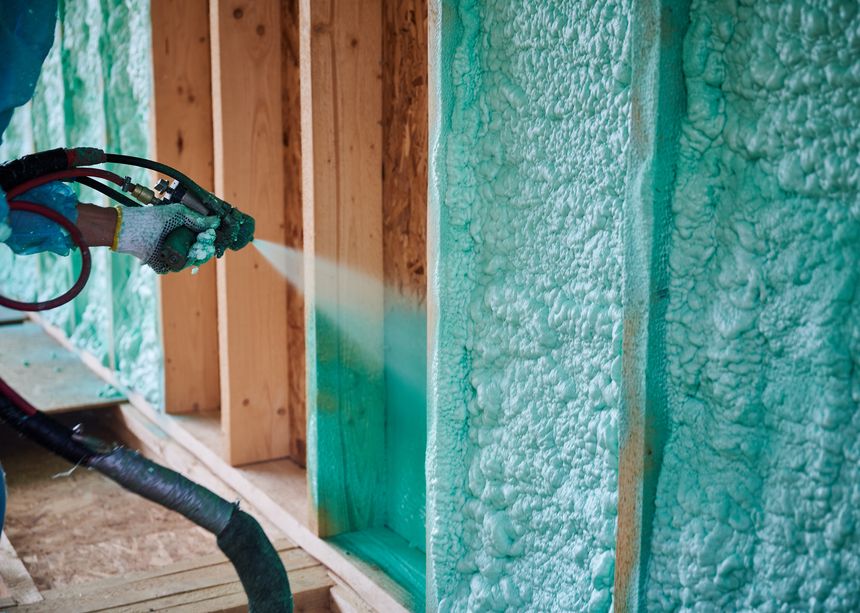
Spray Polyurethane Foam (SPF) is highly regarded for its unmatched ability to seal drafts, reduce energy bills, and boost structural strength. But because SPF is a chemical product mixed and applied live on-site, it involves a unique lifecycle.
A successful spray foam installation involves collaboration between homeowners, contractors, manufacturers, and scientists. Here is a comprehensive look at how spray foam impacts air quality—and how safety is maintained—from the residential environment to the testing laboratory.
1. The Homeowner & Occupant Perspective
Understanding Volatile Organic Compounds (VOCs) in Your Living Space
For property owners, investing in spray foam is about comfort and efficiency. However, because it is applied as a liquid chemical, it is completely natural to wonder about safety, odors, and long-term indoor air quality.
- The "New Car" Connection: When spray foam is applied, it releases Volatile Organic Compounds (VOCs). "Volatile" simply means these compounds easily evaporate into the air at room temperature. It is the same process behind the scent of a new mattress, fresh paint, or a new vehicle.
- The Safety Window: Before these compounds clear out, breathing them in can cause temporary irritation. To keep your family and pets completely safe, there is a strict vacancy window (typically 24-72 hours) while the product cures and the home is thoroughly ventilated prior to occupancy.
2. The Installer & Manufacturer Perspective
Precision Chemistry and Mobile Manufacturing on the Job Site
For the crews and companies putting the product in place, an attic or a crawlspace isn't just a construction zone—it is a live chemical manufacturing plant.
- Controlling the Reaction: Installers precisely measure, heat, and mix two liquid parts together: the A-side (isocyanates) and the B-side (a proprietary blend of polyols, catalysts, blowing agents and fire retardants). When these liquids meet at the spray gun tip, they expand exponentially.
- Professional Containment: Because chemical activity peaks during application, professional installers protect themselves with full-face supplied-air respirators and specialized personal protective equipment (PPE). Their job is to ensure proper chemical ratios, control the indoor environment, and set up high-powered ventilation fans to safely draw VOC-laden air out of the building during the active curing phase.
3. The Analytical Testing Perspective
Replacing Guesswork with Parts-Per-Billion Science
You cannot always rely on your nose to judge air quality. Some harmful VOCs have no odor at all, while some completely harmless chemical scents can linger for a few days. To bridge the gap between installers and homeowners, independent analytical laboratories provide third-party verification.
- Capturing the Sample: Technicians place specialized, pen-sized tubes in a controlled environment which simulates application of product in home. A precise micro-pump draws indoor air through the tube, where a specialized sorbent material acts like a chemical magnet to trap any VOCs present in air during and after installation of the product.
- The Lab "Fingerprint": The tubes are sealed and tested in an accredited laboratory by Gas Chromatography-Mass Spectrometry (GC-MS) analysis. The lab heats the tubes to release the trapped compounds, separates them, and reads their unique molecular "fingerprints." This allows scientists to identify exactly what chemicals are in the air and measure them down to parts-per-billion (ppb).
The Collaborative Bottom Line
By understanding the product lifecycle, enforcing professional containment boundaries, and utilizing rigorous laboratory testing, the industry replaces guesswork with data—ensuring the building is energy-efficient, the workers are protected, and the indoor air is demonstrably safe to breathe.
Explore Intertek’s analytical and chemical testing capabilities: Visit our webiste!
/Passle/5e4a7839abdfeb03584d01f6/MediaLibrary/Images/2026-03-31-21-45-54-751-69cc4092bd1f61a396ba5dbf.png)
/Passle/5e4a7839abdfeb03584d01f6/SearchServiceImages/2026-10-15-20-52-56-997-6ad13d285c647470665fe605.jpg)
/Passle/5e4a7839abdfeb03584d01f6/MediaLibrary/Images/2026-09-03-20-12-26-473-6a99d4aab11f9687508d5b0a.png)
/Passle/5e4a7839abdfeb03584d01f6/SearchServiceImages/2026-09-04-22-12-18-466-6a9b4242f67b2e9362bccbfa.jpg)