


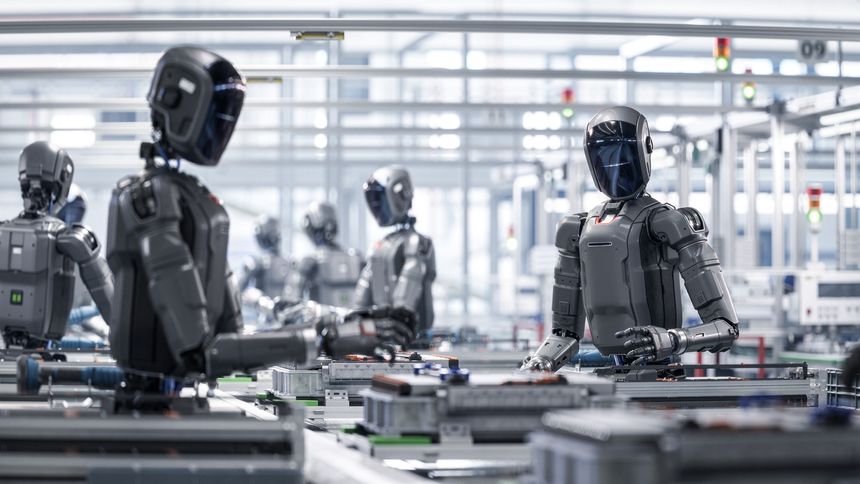
There’s discussion going on right now about a coming “ChatGPT moment” for robotics. One leap forward. A sudden shift from interesting demos to real impact.
It’s a compelling thought, but it’s probably not how this'll play out.
An IEEE Spectrum article makes the case clearly: robotics won’t change because of one breakthrough. It will change because multiple technologies finally start working together—reliably—in the real world.
That’s less dramatic, but it’s a more accurate picture of where we are.
Robots don’t live in clean environments
As I've discussed in other blogs and articles, AI is changing robotics. Instead of telling machines exactly what to do, we’re training them to interpret and respond. Over time, they can start to understand their surroundings and act with a degree of autonomy. But robotics are more than just AI. It’s physics, movement, and interaction.
A robot doesn’t get to reset when something unexpected happens - like an LLM can. It has to deal with it. And the real world is full of things that don’t behave as expected. Lighting changes. People move unpredictably. Objects aren’t where they should be.
That’s the core problem. Not intelligence but complexity.
Why there won’t be a single defining moment
If you look at how robots actually work, the limitation becomes obvious. They aren’t solving one problem, they’re solving several problems at once.
- Understanding the environment
- Deciding what action makes sense
- Executing that action physically
- Doing it all safely, every time
Improving one of these doesn’t fix the others. You can have a very capable vision system and still fail at manipulation. Or excellent motion control with poor decision-making.
That’s why progress feels uneven. And why deployment is so much harder than demonstration.
As the IEEE article points out, this is about integration, not magic.
The gap that actually matters
Most robots look impressive in controlled conditions. That part is no longer the issue. The real challenge starts when they leave those conditions.
In the research and development labs the environment is predictable, the inputs are clean, the scenarios are known, and consequences to failure are minor.
In the real world, none of that holds. Small variations start to matter. Edge cases aren’t rare—they’re constant. This is where systems break down. Not completely, but just enough to create risk.
And from an assurance perspective, that’s the part that matters most.
Learning systems behave differently
Traditionally, automation was deterministic; you could trace behavior directly back to code. AI has changed that.
Systems now learn from data, they generalize, they make decisions based on probabilities rather than fixed rules. This introduces a different kind of challenge. Not unpredictability in a chaotic sense, but variability. The same situation might not always produce the same response - an engineers nightmare. This is manageable, but it requires a different mindset.
- You have to think in terms of ranges, not single outcomes
- You have to test across scenarios, not just validate one
- You have to understand how systems degrade, not just how they perform
That’s a shift in how safety and reliability are evaluated.
How Intertek supports AI robotics assurance
As robotics becomes more AI-driven, assurance has to move beyond traditional product testing. The focus shifts to how systems behave in context.
Intertek supports this in a few key ways.
- Looking at the full system, not just individual components
- Evaluating behavior across real-world scenarios, not ideal ones
- Assessing how systems respond when sensors, data, or conditions change
- Supporting safe integration of AI into existing safety frameworks
This includes functional safety, human–robot interaction, and system-level risk assessment.
The goal isn’t to slow innovation down. It’s to make sure these systems can operate safely once they leave controlled environments and start interacting with people.
Trust is the real milestone
There will be technical breakthroughs in robotics and some are already happening.
But the real milestone isn’t capability, it’s confidence.
Can the system operate reliably when conditions shift?
Can it handle the unexpected without creating new hazards?
Can people work alongside it without needing to second-guess it?
Those questions don’t get answered by a single advance. They get answered over time, through consistent performance and strong assurance.
Robotics won’t suddenly arrive. It will prove itself, step by step, as systems become dependable enough to trust
Final thought
We tend to ask what robots can do, but a better question is: What will they do when things don’t go as planned.
That’s where the real work is. And that’s where assurance becomes essential.
/Passle/5e4a7839abdfeb03584d01f6/MediaLibrary/Images/2026-03-31-21-45-54-751-69cc4092bd1f61a396ba5dbf.png)
/Passle/5e4a7839abdfeb03584d01f6/SearchServiceImages/2026-10-15-20-52-56-997-6ad13d285c647470665fe605.jpg)
/Passle/5e4a7839abdfeb03584d01f6/MediaLibrary/Images/2026-09-03-20-12-26-473-6a99d4aab11f9687508d5b0a.png)
/Passle/5e4a7839abdfeb03584d01f6/SearchServiceImages/2026-09-04-22-12-18-466-6a9b4242f67b2e9362bccbfa.jpg)